How many ways are there to weld lithium batteries? Are there any precautions when welding lithium batteries?
2024-01-04
let me tell you about the current methods of welding lithium batteries and their advantages and disadvantages:
1.spot welding
Spot welding is a traditional welding method that forms a connection by placing two metal parts between electrodes and applying a high current to momentarily heat and press them together.
The advantages of spot welding are: fast speed, high precision, and the ability to efficiently connect small-area electrodes.
Disadvantages of spot welding: limited by the connection area, it cannot be used for larger electrodes. The connection strength is poor and prone to breakage and other problems. Due to the high current required, more heat will be generated, which may cause damage to other components.
2.laser welding
Laser welding is a non-contact welding method that uses a laser beam to generate high temperatures on the metal surface, causing it to melt and join together.
The advantages of laser welding are: fast speed, high precision, no need for additional filling materials, and can be applied to electrodes of various shapes and sizes.
Disadvantages of laser welding: The equipment is expensive and the cost is high. It requires skilled operators to control, and the technical threshold is high. Due to the high energy of the laser beam, deformation or damage to the electrode may occur.
3.Ultrasonic welding
Ultrasonic welding is a welding method that uses high-frequency vibrations to heat and press metal parts together.
The advantages of ultrasonic welding: no preheating is required, and the heat treatment step is omitted. It has fast speed, high precision, and does not produce waste gas, waste residue and other pollutants.
Suitable for electrodes of various shapes and sizes.
Disadvantages of ultrasonic welding: a high-quality interface is required, otherwise the quality of the connection cannot be guaranteed. Welding depth is limited by amplitude and time and cannot be used with thicker metal parts. Noise and vibration may occur during welding.
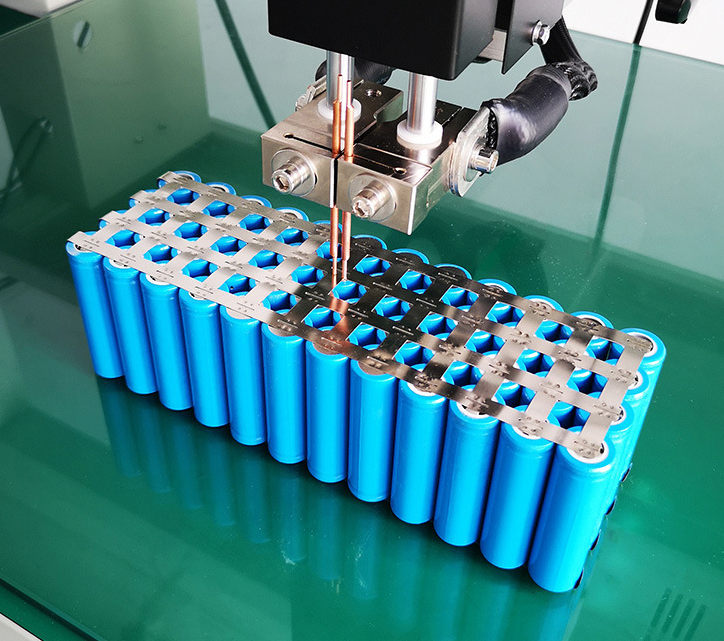
Next we will analyze the precautions during the welding process.
1. First of all, the cells must be arranged neatly on the cell holder according to the battery pack process specifications. Pay attention here that the positive and negative poles of the cells cannot be placed incorrectly, otherwise it will cause a short circuit in the battery pack.
2. Place the nickel sheet accurately according to the process design requirements of the battery pack.
3. During the welding process, it is necessary to keep no other impurities remaining on the surface of the nickel sheet and the battery core, otherwise there will be explosions and other poor welding conditions.
4. The solder joints should be evenly distributed and arranged neatly, and do not have partial solder joints or solder joints between the positive and negative electrodes.
5. Pay attention to the number of solder joints. Welding the battery pack usually requires spot welding twice to form four solder joints. Avoid false soldering at solder joints and reduce the probability of false soldering.
6. The more welding points, the better the conductivity and the higher the solidity. However, for general battery pack welding, four welding points are enough. The number of solder joints depends on the battery pack process design requirements.
7. When spot welding, be careful not to place conductive objects on the work surface, and not to wear watches, rings and other metal objects. Protective equipment such as goggles and insulating gloves should be worn.
8. Regularly polish the front end of the soldering pin to prevent impurities produced by oxidation of the soldering pin surface from causing poor welding.
9. When welding a larger battery pack, an epoxy plate should be placed. After the welding is completed, the epoxy plate should be covered with that part, and then the other part should be welded to prevent welding spatter and other phenomena.
10. Select appropriate wire diameter and material. When selecting wires, you need to consider their conductive properties and whether they meet the requirements for lithium battery manufacturing.
11. The laser temperature should be adjusted according to the wire material. The welding temperatures for wires of different materials are different and need to be adjusted according to specific conditions.
12. Do not use laser welding for too long to avoid wire deformation and weakening of mechanical strength.
It should be noted that no matter which welding method is used, the battery needs to be protected to prevent the battery from being damaged by overheating or overcurrent. At the same time, make sure the positive and negative poles are not short-circuited during welding to avoid battery damage or safety accidents. If you are welding for the first time, pay attention to safety measures and perform welding under the guidance of professionals.
Is it safe to mix different types of lithium-ion batteries together?
What are the errors of the first charge of lithium battery?