introduction to lithium battery knowledge--lithium battery parameters and precautions
2023-12-27
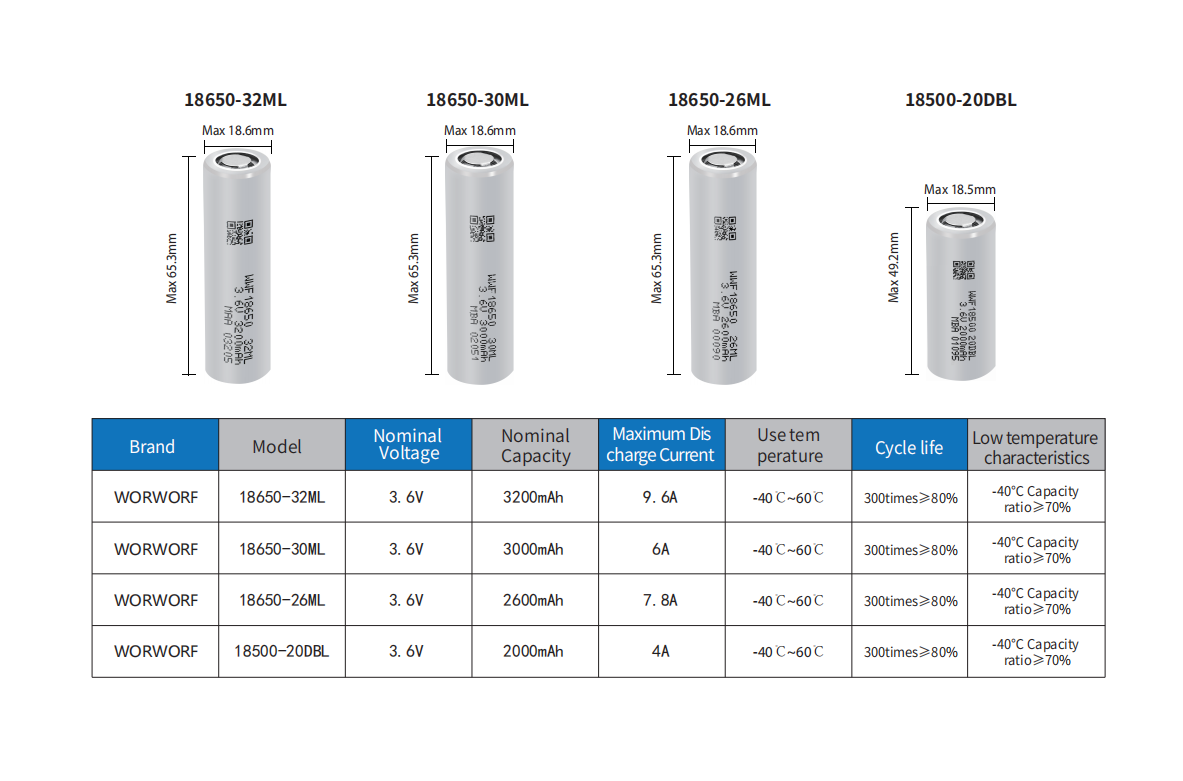
Lithium battery parameters
1.Voltage
- nominal voltage
The potential difference between the positive and negative electrodes of a lithium battery is called the nominal voltage of the lithium battery. The nominal voltage is determined by the electrode potential of the plate material and the concentration of the internal electrolyte.
- open circuit voltage
The terminal voltage of a lithium battery in an open circuit state is called the open circuit voltage. The open circuit voltage of a lithium battery is equal to the difference between the reduction electrode potential of the positive electrode and the negative electrode potential of the lithium battery.
- Operating Voltage
The working voltage refers to the voltage displayed during the discharge process of the lithium battery after being connected to the load, also known as the discharge voltage. The operating voltage at the beginning of the lithium battery discharge is called the initial voltage.
Recommended voltages commonly used for lithium batteries:
12V lithium battery
24V lithium battery
36V lithium battery
48V lithium battery
2.Capacity
The amount of electricity that a lithium battery can provide under certain discharge conditions is called the capacity of the lithium battery, represented by the symbol C. The commonly used unit is ampere-hour, referred to as ampere-hour (Ah) or milliampere-hour (mAh).
The capacity of lithium batteries is affected by the cathode material used, battery temperature, discharge rate, voltage, etc.
3. Internal resistance
The internal resistance of a lithium battery refers to the resistance encountered when current passes through the interior of the lithium battery. The internal resistance will affect the voltage of the lithium battery.
4.Cycle life
The cycle life of a lithium battery is generally expressed in terms of the number of uses. One cycle represents a complete charge and discharge cycle of the lithium battery (that is, the lithium battery is charged from empty to full, and then discharged from full to empty).
Note: Lithium batteries have good cycle characteristics and can generally maintain about 80% of their capacity after 500 cycles.
5. Discharge rate
The discharge rate refers to the current size of the lithium battery when discharging, generally expressed by C, and expressed by the formula:
Discharge rate = discharge current/rated capacity
Note: Since lithium batteries use organic solvent electrolytes, the conductivity is generally only a few hundredths of that of lead-acid or alkaline battery electrolytes. Therefore, when a lithium-ion battery is discharged with a large current, it is too late to replenish Li+ from the electrolyte, and a voltage drop will occur.
6. Working temperature
The operating temperature of a lithium battery refers to the environment and the temperature of the battery itself that the lithium battery can adapt to while maintaining normal charging and discharging operations.
When lithium batteries are at low temperatures, the discharge platform decreases to a certain extent. High temperatures will affect the cycle performance of the battery and cause the battery to expand slightly. Therefore, batteries are generally recommended to work within the range of 0-40°C.
2. Lithium battery PACK
Lithium battery PACK mainly refers to the processing and assembly of lithium batteries. It mainly processes the battery cells, protective boards, BMS, connecting sheets, label paper, etc. into the products that customers need through the battery PACK process.
How to use lithium batteries correctly
Lithium battery storage:
The most critical storage conditions for lithium batteries are temperature and humidity. It is recommended to store them in an environment with a temperature of 20°C. Pay attention to moisture-proofing and do not let the lithium batteries be in a depleted state. Do not squeeze, collide, or store in places with strong static electricity and strong magnetic fields.
Lithium battery use:
Avoid overcharging and over-discharging: Avoid charging the battery to too high a voltage or discharging it to too low a voltage. Most lithium batteries have recommended charging and discharging voltage ranges. Be aware of these ranges when using chargers and devices.
- Avoid Overheating and Cooling: Lithium battery performance can be affected at different temperatures. Try to avoid placing the battery in extreme temperature environments, especially high temperature environments. Overheating can cause battery performance to degrade or even be damaged.
- Avoid overcharging: Leaving a battery charged for an extended period of time may negatively affect its lifespan. Once the battery is fully charged, it's a good idea to disconnect the charger.
- Regular charging: If the lithium battery is not used for a long time, it is recommended to charge it regularly. Charging helps maintain battery performance and prevents self-discharge, which causes the battery to lose energy.
- Avoid physical damage: Lithium batteries are delicate devices. Avoid exposing the battery to physical damage, crushing or impact. Physical damage can cause battery short circuits or other safety issues.
- Avoid rapid discharge: Avoid rapidly discharging the battery in a short period of time, especially with battery types that do not support high discharge rates. This can reduce battery cycle life.
What are the errors of the first charge of lithium battery?
What are the factors affecting the self-discharge of lithium batteries?